

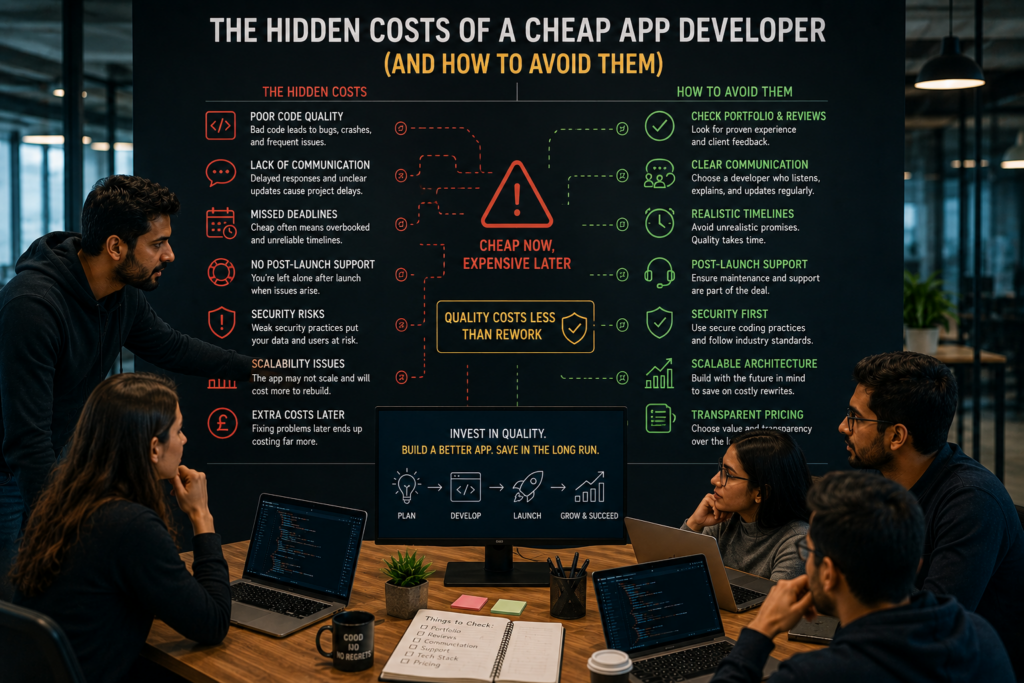
Every business wants good value. That is entirely reasonable. But in the world of software development, there is a critical difference between good value and cheap — and confusing the two is one of the most expensive mistakes a business can make.
This post is for anyone who has received a quote from a professional UK app development agency and then found a freelancer, cheap app developer or offshore team offering to do the same job for a fraction of the price. Before you make that decision, you need to understand what that price difference actually represents — and what it is likely to cost you later.
Why the Initial Price Is Rarely the Real Cost
App development is not a commodity. Unlike buying a laptop or commissioning a logo, the quality of the work is almost entirely invisible until it fails. You cannot look at two apps on paper and immediately tell that one has a fragile architecture, no automated tests, security vulnerabilities, and code so poorly documented that no other developer will be able to maintain it. You only discover that six months after launch, when things start going wrong.
The cheap quote gets you in the door. The rebuild, the emergency support, the lost customers, and the reputational damage are what you really pay for.
What Cheap App Developers Are Typically Cutting
1. Discovery and Requirements Analysis
Professional app development begins with a structured discovery phase — workshops, user research, technical scoping, and specification documentation. This is expensive and time-consuming, which is why it is the first thing budget developers skip. Without it, the project is built on assumptions rather than validated requirements. The result is an app that technically works but does not solve the right problem in the right way.
2. UX Design and Usability Testing
Great UX design is the difference between an app that users love and one that they delete after the first session. Proper UX involves user journey mapping, wireframing, prototype testing with real users, and iterative refinement before development begins. Cheap app developers either skip this entirely — handing you a generic template — or outsource it to someone who has never spoken to your users.
3. Code Quality and Architecture
There are many ways to write code that appears to work. Some of those ways are clean, well-structured, and easy to build upon. Others are fragile, poorly organised, and impossible to maintain. Inexperienced or incentivised-to-rush app developers often produce the latter. You will not know the difference until you ask a reputable agency to add a new feature and they tell you the entire codebase needs to be refactored first.
4. Testing and Quality Assurance
A thorough QA process involves functional testing, usability testing, performance testing, security testing, and compatibility testing across multiple devices and OS versions. This takes time and requires specialist skills. On cheap projects, testing is often limited to the developer checking that the main flows seem to work on their own phone. The result is bugs in production, crashes on specific devices, and security vulnerabilities that go undetected until they are exploited.
5. Security
Security is not something you can add after the fact. It must be built into the architecture from the ground up — proper authentication and authorisation, encrypted data storage, secure API communication, protection against common vulnerabilities such as SQL injection and cross-site scripting. Cheap app developers routinely cut corners on security. For consumer apps handling personal data, or any app covered by GDPR, this is not a minor problem — it is a compliance and legal risk.
6. Documentation
Professional app development produces clear technical documentation — architecture diagrams, API specifications, code comments, deployment guides, and handover notes. Without this, your app becomes hostage to the people who built it. If your relationship with your developers ends (and with cheap, offshore teams this happens regularly), you may find yourself with a working app that no one else can maintain or build upon.
The Real Cost: Three Scenarios
Scenario 1: The App That Never Gets Finished
A business pays a freelancer £12,000 for an app. After four months of delays and excuses, the freelancer disappears with the project 60 per cent complete. The code is unstructured and partially undocumented. A reputable agency quotes £45,000 to finish and properly rebuild the project. Total cost: £57,000 — nearly four times what they thought they were paying.
Scenario 2: The App That Launches and Immediately Has Problems
An offshore team delivers a working app on time and on budget. Within three months of launch, users are reporting crashes on Android 14, a payment flow bug is causing failed transactions, and a security researcher discovers that user data is being stored without encryption. The business needs emergency development support, faces a potential ICO investigation under GDPR, and loses significant customer trust. Emergency remediation and a security audit cost £30,000 on top of the original £18,000 build.
Scenario 3: The App That Cannot Grow
A start-up builds an MVP with a cheap development team. The app works and early users like it. The business raises investment and wants to build out the platform. A new agency reviews the codebase and finds that the architecture cannot support the required scale — it would need to handle 10,000 concurrent users but was built for a few hundred. Migrating and rebuilding the back end adds £60,000 and six months to the roadmap, delaying the product launch that investors were expecting.
Red Flags When Evaluating App Developers
Here is what to watch for when reviewing quotes and agency credentials:
- Suspiciously low prices: If the quote is less than half the market rate for comparable UK work, ask detailed questions about what is included. The answer will tell you what is being omitted.
- No discovery phase in the proposal: Any serious app development project should include a structured discovery phase before development begins. If the proposal jumps straight to building, that is a warning sign.
- Vague specifications: A professional quote will specify exactly what features are included, what platform(s) are covered, what design deliverables are included, what the testing process involves, and what happens after launch.
- No portfolio of live apps: Can you download and use apps they have built? Can you speak to their clients? If the answer to either question is no, walk away.
- Communication delays during the sales process: If they are slow to respond, disorganised in meetings, and unclear in their proposals before they have your money, it does not improve once they do.
- No clear IP assignment: Ensure any contract clearly assigns intellectual property rights to you. Some unscrupulous developers retain ownership of the code they write for you.
- No mention of security or GDPR: Any app that handles personal data must be built with data protection in mind. If security and compliance are not mentioned in the proposal, they are probably not being considered.
How to Get Genuine Value Without Overpaying
Getting great value from app development does not mean paying the highest price — it means paying an appropriate price for genuinely skilled, well-managed work. Here is how to do that:
- Get at least three quotes from reputable UK-based or well-established nearshore agencies.
- Ask each agency to walk you through their development process in detail — discovery, design, sprints, testing, deployment.
- Check their portfolio. Download their apps. Read their case studies. Speak to their past clients.
- Compare quotes on the basis of what is included, not the headline number.
- Invest in the discovery phase. A thorough specification reduces risk for everyone.
- Prioritise agencies that push back on your brief and ask hard questions — that is a sign of professional integrity, not awkwardness.
- Ensure the contract includes IP assignment, source code handover, and a warranty period.
Final Thoughts
The cheapest app developers are rarely cheap. The costs just arrive later — in delays, rebuilds, lost customers, legal exposure, and missed market opportunities. The businesses that get the best long-term outcomes from app development are those that treat it as a strategic investment, choose partners based on quality and trust rather than headline price, and are willing to invest properly in doing it right the first time.
If you have received a quote that seems too good to be true, it almost certainly is. Take the time to understand why before you sign anything.
Get a quote you can actually trust
We’re a UK-based app development agency that does discovery properly, writes code you can build on, and hands over everything you own. No surprises. No shortcuts.
No obligation. We’ll give you an honest assessment — even if the answer is that you don’t need us yet.