
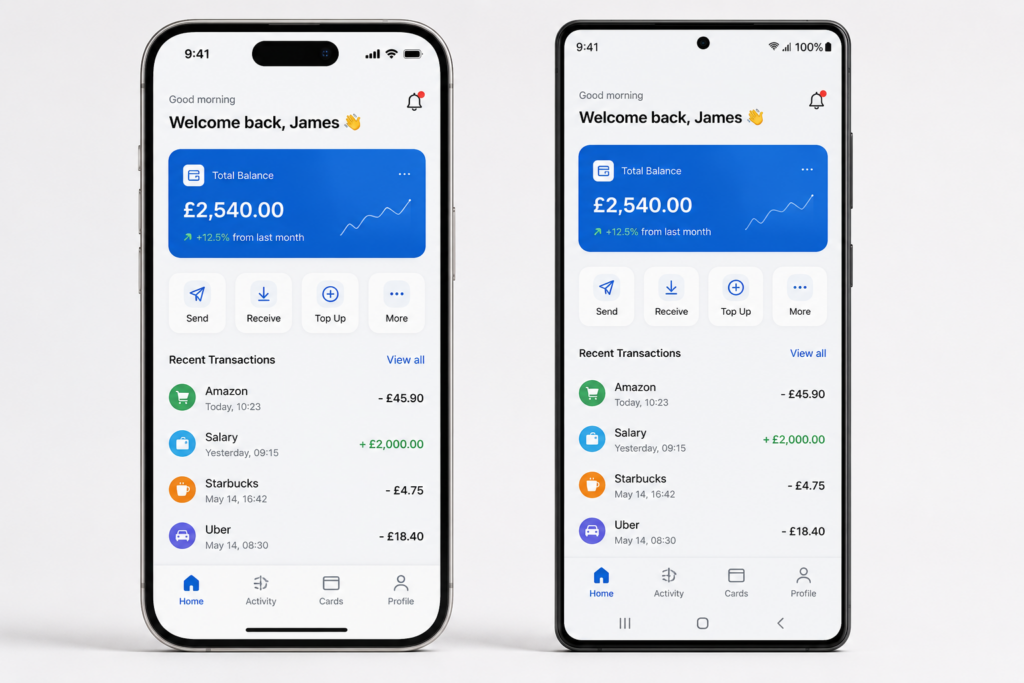
Flutter has become the framework of choice for cross-platform mobile development for good reason. Developed by Google and using the Dart programming language, Flutter delivers a genuinely native-quality experience on both iOS and Android from a single shared codebase — without the performance compromises that plagued earlier cross-platform approaches.
At Stakk, Flutter is now our default recommendation for most commercial cross-platform projects, and understanding why it has earned that status will help you make the right decision for your own product.
What Is Flutter and How Does It Work?
Flutter works differently from other cross-platform frameworks. Rather than relying on native UI components or a web view, Flutter renders its own UI using Skia (now Impeller), Google’s high-performance graphics engine. Every pixel on the screen is drawn by Flutter itself, which is why Flutter apps look identical on iOS and Android and why animations and transitions are exceptionally smooth.
Flutter vs React Native in 2026: The Key Differences
React Native renders native UI components, giving apps a platform-native look and feel by default but introducing a JavaScript bridge that can create performance bottlenecks under heavy load. Flutter’s custom renderer eliminates this bridge entirely, producing consistently smoother animations and better performance in graphics-intensive applications. For most commercial business apps — SaaS platforms, e-commerce, marketplace tools — both frameworks perform excellently, but Flutter’s architectural advantages make it the more future-proof choice.
When Should You Choose Flutter?
- Visual richness matters — Flutter’s custom renderer delivers pixel-perfect designs and buttery smooth animations.
- Cross-platform consistency — when your brand demands identical appearance on iOS and Android.
- Expanding beyond mobile — Flutter targets iOS, Android, web, desktop, and embedded devices from one codebase.
- Greenfield projects — starting fresh? Flutter’s modern architecture and tooling make it the smartest foundation.
| ⚡ BUILD WITH FLUTTER — LAUNCH ON BOTH PLATFORMS Stakk’s Flutter team delivers stunning, high-performance iOS and Android apps from a single codebase. Faster delivery, lower cost, better results. [ BUTTON: Get Your Free Strategy Session → ] |
Frequently Asked Questions
Everything UK businesses need to know about Flutter app development in 2026.
What is Flutter and who uses it?
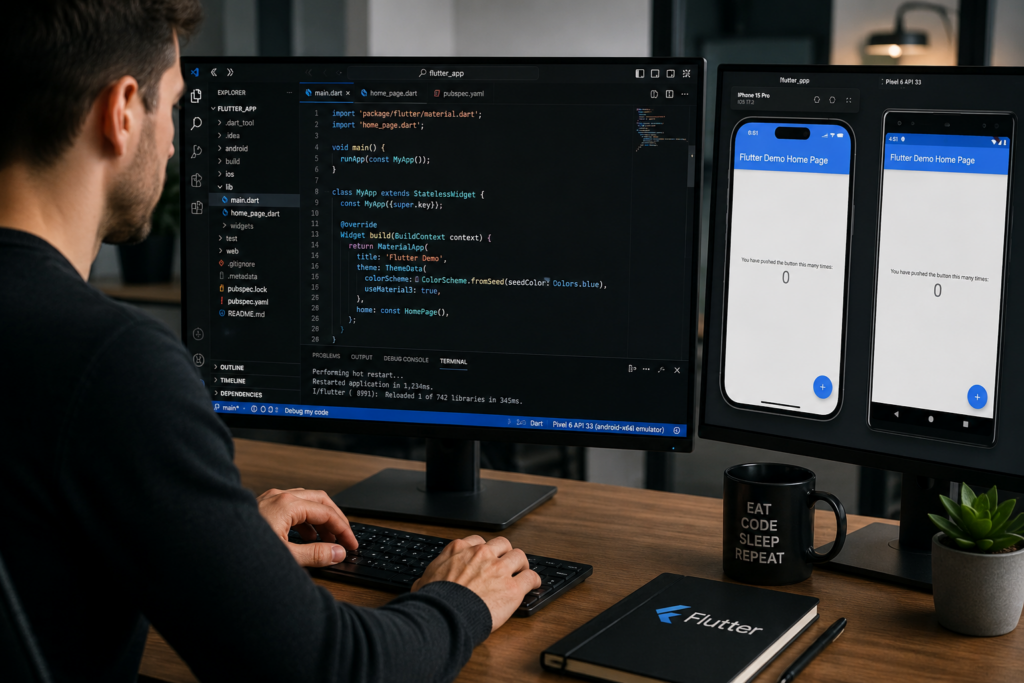
Flutter is Google’s open-source UI framework for building natively compiled applications for mobile, web, and desktop from a single Dart codebase. It is used in production by major companies including BMW, Alibaba, Nubank, and Reflectly. Flutter’s distinctive approach — rendering its own UI using a custom graphics engine rather than native components — gives it exceptional performance and visual consistency across all platforms.
Is Flutter better than React Native for app development in 2026?
Flutter and React Native are both mature, production-ready frameworks in 2026. Flutter has architectural advantages in rendering performance, UI consistency, and expanding platform support (iOS, Android, web, desktop). React Native has a larger existing developer community and integrates more naturally with JavaScript and TypeScript codebases. For most new commercial projects, Stakk recommends Flutter — but the right choice depends on your team’s existing skills and your project’s specific requirements.
How much does Flutter app development cost?
Flutter app development typically costs between £25,000 and £200,000+ in the UK, broadly similar to other cross-platform approaches. The key cost advantage of Flutter comes from building both iOS and Android simultaneously from one codebase, reducing total cost by 30 to 50 per cent compared to two separate native builds. Complexity, feature set, back-end requirements, and design investment are the primary cost drivers.
What is Dart and do I need to know it?
Dart is Google’s programming language used to write Flutter applications. It is a strongly-typed, object-oriented language with a syntax that will feel familiar to developers with experience in Java, Kotlin, JavaScript, or Swift. You do not need to know Dart before commissioning a Flutter app — your development team handles all code — but understanding that Dart is the underlying language helps you assess a developer’s technical claims.
Can Flutter apps be submitted to both the App Store and Google Play?
Yes, Flutter apps compile to native iOS and Android binaries that are submitted to the App Store and Google Play through the same processes as any native app. From a user’s perspective, a Flutter app is indistinguishable from a native app in the store or on-device. Stakk manages the full submission process for both platforms on behalf of our clients.
Does Flutter support all device features like camera, GPS, and push notifications?
Yes, Flutter supports all major device features through its extensive plugin ecosystem (pub.dev). Camera, GPS, push notifications, biometric authentication, Bluetooth, NFC, local storage, in-app payments, and the vast majority of device capabilities are available through well-maintained plugins. For unusual or very new device features, native platform channel code can bridge any gap.
Can I use Flutter for web and desktop apps as well?
Yes, Flutter supports web, macOS, Windows, and Linux in addition to iOS and Android. This multi-platform capability is one of Flutter’s strategic advantages — a team familiar with your Flutter mobile codebase can also build or maintain a companion web or desktop app from the same shared logic. Web support has improved significantly and is production-ready for most use cases in 2026.
Is Flutter suitable for enterprise app development?
Yes, Flutter is suitable for enterprise app development and is used by major enterprises globally. Flutter supports complex state management architectures, enterprise authentication systems (OAuth, SAML, LDAP), offline-first capabilities, device management integration for MDM platforms, and large-scale codebases. Its performance characteristics and strong Google backing make it a credible choice for enterprise mobile programmes.
How do I find Flutter developers in the UK?
To find Flutter developers in the UK, search for agencies with a published Flutter portfolio on their website and GitHub, look for developers contributing to Flutter’s open-source ecosystem on pub.dev, review specialist job platforms, and request Flutter-specific case studies from agencies you are considering. A credible Flutter developer should be able to explain their approach to state management, testing, and architecture patterns.
Can Stakk migrate my existing app to Flutter?
Yes, Stakk’s Flutter developers can assess your existing iOS or Android app for migration to Flutter. Migration is typically a rebuild of the front-end UI layer using Flutter while preserving or evolving the back-end services. A phased approach — migrating feature by feature — is often more manageable than a big-bang rewrite. We begin every migration engagement with a thorough technical review and a clear, costed roadmap.
About the Author
| Jack Tyson | Director, Stakk Jack Tyson is the Director of Stakk and has spent 12 years building mobile applications for start-ups, scale-ups, and global brands. With hands-on experience across iOS, Android, and cross-platform development, Jack brings both technical expertise and commercial insight to every project. 🔗 Connect with Jack: LinkedIn URL |
Blog Post 110 | Primary Keyword: Flutter app development | Stakk Content | Published: June 2026
Estimated reading time: 6 minutes