

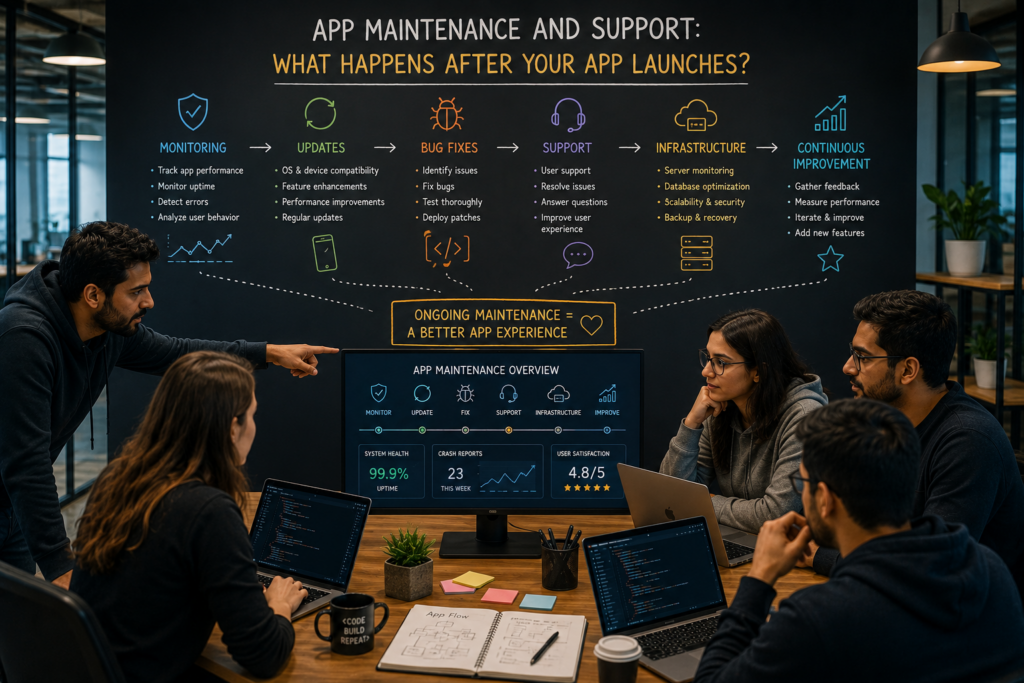
Launching your app is not the end of the journey — it is the beginning of a different one. Many businesses invest significantly in getting their product built and to market, only to be surprised by the ongoing commitment required to keep it running, secure, and competitive. App maintenance is not an optional extra; it is a fundamental part of owning a digital product.
This guide explains everything that happens after launch day — what app developers need to do to keep your product healthy, how much ongoing maintenance costs, and how to choose the right support model for your business.
Why Apps Need Ongoing Maintenance
An app is not like a building that stays the same once it is built. It exists in an environment that changes constantly — Apple and Google update their operating systems multiple times a year, device hardware evolves, third-party services your app depends on update their APIs, and user expectations shift. An app that is not actively maintained will degrade. Features stop working, performance drops, security vulnerabilities emerge, and eventually the app is removed from the App Store because it no longer meets platform requirements.
Beyond keeping the lights on, maintenance is also how you improve your product. Post-launch analytics reveal how users actually behave versus how you expected them to. Crash reports identify bugs that slipped through QA. User feedback generates a backlog of improvements that can make the difference between an app people tolerate and one they actively recommend.
The Core Components of App Maintenance
1. Operating System Compatibility Updates
Apple releases a major iOS update each autumn, typically in September. Google releases major Android updates on a rolling basis throughout the year. Each update can break functionality in existing apps — UI components that no longer render correctly, APIs that are deprecated, permission models that change. Keeping your app compatible with the latest OS versions is not optional if you want it to remain visible and functional on users’ devices.
A well-built app developed using current best practices will require fewer emergency fixes when new OS versions land. This is one of the reasons investing in quality development up front pays dividends over the lifetime of a product.
2. App Store and Google Play Compliance
Both Apple and Google regularly update their store policies and technical requirements. Apps that do not comply are rejected at update submission or, in some cases, removed from the store entirely. Recent examples include mandatory support for 64-bit architectures, IPv6 networking requirements, new privacy manifest declarations on iOS, and updated data safety declarations on Android. Your app developers need to monitor these changes proactively and update your app before deadlines hit.
3. Security Patches and Vulnerability Management
Security vulnerabilities are discovered in frameworks, libraries, and code patterns on a continuous basis. Open-source libraries that your app depends on — for authentication, networking, data storage, or UI rendering — regularly release security patches. Failing to apply these patches leaves your app and your users’ data exposed. For any app that handles personal data, this is not just a technical concern — it is a GDPR obligation.
Your maintenance agreement should include regular dependency audits and a defined process for applying critical security patches outside of the regular release cycle.
4. Bug Fixing and Performance Monitoring
No app launches without bugs. Some will be discovered by QA and fixed before launch; others will only emerge under the unpredictable conditions of real-world use — specific device configurations, unusual user behaviour, edge cases that no test suite could anticipate. A real-time crash reporting tool such as Firebase Crashlytics, Sentry, or Bugsnag should be configured from launch day to capture and prioritise these issues.
Performance monitoring is equally important. Response times, API latency, and app loading times should be tracked continuously. Performance problems that are not caught early tend to compound — a slow app loses users, and lost users are extremely hard to win back.
5. Third-Party API and Service Management
Most modern apps depend on external services — payment gateways such as Stripe or Braintree, mapping services such as Google Maps or Mapbox, authentication providers such as Auth0, and any number of business-specific integrations. These services update, deprecate endpoints, change pricing models, and occasionally go down. Your app developers need to monitor these dependencies and update integrations proactively.
6. Content and Data Management
If your app serves content — product listings, articles, pricing, media — that content needs to be managed, updated, and occasionally restructured. Even apps that do not serve editorial content will accumulate data that needs to be monitored, backed up, and occasionally migrated as the data model evolves.
Post-Launch Iteration and Feature Development
Maintenance is about keeping your app healthy. Iteration is about making it better. The most successful app businesses treat launch as the beginning of a continuous improvement cycle rather than a finish line.
Post-launch, your analytics will reveal which features users engage with, where they drop off, which flows are confusing, and which capabilities they are asking for. A structured sprint cycle — typically fortnightly or monthly — allows your app developers to prioritise, build, test, and release improvements continuously. This is how good apps become great ones.
Businesses that commit to ongoing iteration consistently outperform those that build and abandon. The gap in user retention, App Store ratings, and long-term commercial performance is significant.
How Much Does App Maintenance Cost?
A useful rule of thumb is to budget 15 to 20 per cent of your initial build cost per year for ongoing maintenance and support. For a £60,000 app, that is approximately £9,000 to £12,000 per year for a basic maintenance retainer. This typically covers:
- OS compatibility updates when major iOS and Android versions are released.
- App Store and Google Play policy compliance updates.
- Security patch management and dependency audits.
- Bug fixing and crash resolution.
- Monthly performance and uptime monitoring review.
- A defined number of hours per month for minor enhancements or content updates.
Feature development — adding new capabilities, redesigning sections, or integrating new services — is typically scoped and priced separately, either as fixed-price projects or via a time-and-materials retainer.
In-House Maintenance vs Agency Retainer
In-House Development
Hiring an in-house developer for maintenance makes sense when you have a large, complex app with continuous development needs, and when you need that developer to have deep contextual knowledge of the product. The cost is significantly higher — a mid-level mobile developer in the UK costs £50,000 to £80,000 in salary, plus employer’s National Insurance, pension contributions, equipment, and management overhead. You also carry the risk of attrition and the challenge of keeping a single developer’s skills current across a rapidly changing technology landscape.
Agency Retainer
For most businesses, a maintenance retainer with the agency that built your app is the most efficient and cost-effective approach. The agency already knows your codebase, your infrastructure, and your business context. They can respond quickly to critical issues, scale resource up or down as needed, and bring specialist skills (iOS, Android, back-end, DevOps, security) on demand without you needing to employ those skills full time.
When evaluating a maintenance retainer, look for clear SLAs — response time commitments for critical versus non-critical issues — a defined monthly scope, transparent reporting, and a process for escalating and prioritising requests.
Questions to Ask Your App Developers About Post-Launch Support
- What monitoring tools will you put in place at launch to detect crashes and performance issues?
- What is your process for managing OS updates — how much notice will I get, and what does the update process involve?
- How quickly can you respond to a critical production issue?
- What is included in your maintenance retainer versus what is billed separately?
- How will you communicate changes to third-party services that affect my app?
- How do you handle security disclosures and emergency patches?
Final Thoughts
Building your app is a significant achievement. Keeping it running, secure, and improving is the ongoing commitment that determines whether that achievement pays off commercially over the long term. Businesses that plan for post-launch maintenance from the outset — budgeting for it, structuring the right support agreement, and committing to continuous iteration — consistently get a better return on their app investment than those who treat launch as the end of the project.
Talk to your app developers about maintenance before you sign the development contract. The conversation will tell you a great deal about their professionalism and their commitment to your long-term success.
Most businesses budget carefully for the build — and forget to plan for everything that comes after. iOS updates, security patches, App Store compliance, third-party API changes — an unmaintained app degrades fast.
Stakk offers ongoing support retainers that keep your app secure, compatible, and improving long after launch day.
Talk to Stakk about post-launch support →
Flexible retainers · No long-term lock-in