

Enterprise app development operates in a fundamentally different context from consumer app development. The users are employees or partners rather than customers, the deployment environment is a managed corporate fleet rather than an open app store, and the non-negotiable requirements — security, compliance, SSO integration, and offline capability — are vastly more demanding.
The best consumer apps win through delight; the best enterprise apps win through reliability, integration, and the ability to operate within the constraints of a corporate IT environment without compromising either.
What Makes Enterprise App Development Different?
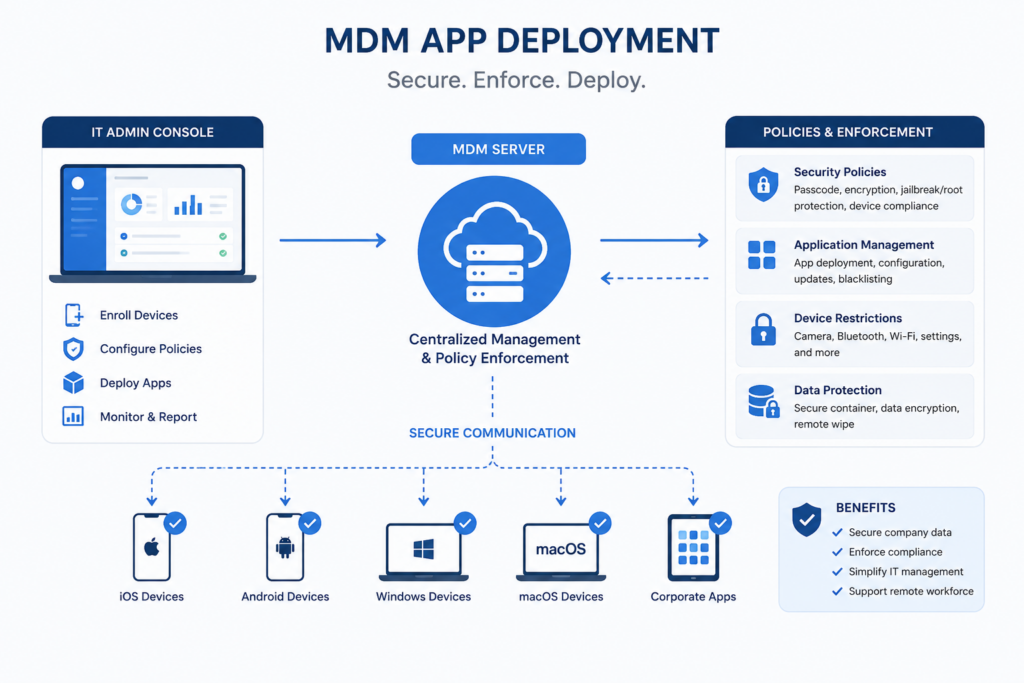
Enterprise apps must integrate with existing corporate systems — Active Directory, ERP platforms, CRM systems, and data warehouses. They must support Single Sign-On via standards such as SAML 2.0 and OAuth 2.0 with corporate identity providers including Microsoft Azure AD, Okta, and Google Workspace. They must be deployable through Mobile Device Management (MDM) platforms such as Microsoft Intune, Jamf, and VMware Workspace ONE.
Critical Enterprise App Requirements
- SSO and identity federation — employees log in once with their corporate credentials; no separate app account.
- MDM compatibility — apps must be deployable, configurable, and remotely wipeable through enterprise MDM systems.
- Offline-first architecture — field workers, warehouse teams, and travelling employees need apps that work without connectivity.
- Role-based access control — granular permissions aligned to corporate roles and organisational hierarchy.
- Audit logging — comprehensive activity logs for compliance, security monitoring, and incident investigation.
Build vs Buy for Enterprise Mobile Apps
The build-vs-buy decision for enterprise apps depends on how differentiated your requirements are. Generic workflow apps, document management, and communication tools are well-served by existing platforms. But apps that must reflect specific business processes, integrate with proprietary systems, or provide a competitive advantage in operations almost always justify a custom build — particularly when the alternative is forcing employees into workflows designed for a generic organisation rather than yours.
| 🏢 BUILD ENTERPRISE APPS YOUR IT TEAM WILL APPROVE SSO, MDM, offline-first, and enterprise-grade security — Stakk’s enterprise development team delivers apps that meet corporate requirements without compromise. Free consultation. |
Frequently Asked Questions
Enterprise IT and procurement teams ask these questions most often about mobile app development.
What is enterprise app development?
Enterprise app development is the process of building mobile or web applications specifically for use within a large organisation — by employees, partners, or supply chain participants. Enterprise apps typically integrate with existing corporate systems (ERP, CRM, HR platforms), support corporate authentication via SSO, are deployed through MDM systems, and must meet strict security and compliance standards. Common examples include field service apps, warehouse management tools, sales force automation, and internal communication platforms.
How much does enterprise app development cost?
Enterprise app development typically costs between £80,000 and £600,000+ depending on the complexity of integrations, the number of user roles and workflows covered, the security and compliance requirements, and whether the app is deployed on a single platform or multi-platform. Enterprise projects tend to cost more than equivalent consumer apps due to the extensive integration work, security architecture, testing across device fleet configurations, and governance documentation required.
What is MDM and why does it matter for enterprise apps?
MDM (Mobile Device Management) is the technology enterprises use to manage, secure, and configure corporate mobile devices at scale. Enterprise apps must be compatible with MDM deployment — meaning they can be distributed through MDM without the App Store, configured remotely using Managed App Configuration, and remotely wiped if a device is lost or stolen. Major MDM platforms include Microsoft Intune, Jamf Pro, VMware Workspace ONE, and SOTI. Incompatibility with the client’s MDM platform is a common and costly oversight in enterprise app projects.
What is SSO (Single Sign-On) and how is it implemented in mobile apps?
Single Sign-On allows enterprise users to authenticate with their corporate credentials once and access all authorised applications without logging in separately to each. In mobile apps, SSO is implemented using industry standards including SAML 2.0 and OpenID Connect / OAuth 2.0, integrated with corporate identity providers such as Microsoft Azure Active Directory, Okta, Ping Identity, or Google Workspace. The implementation requires co-ordination with the client’s IT and security teams to configure the identity provider correctly.
What does offline-first mean in enterprise app development?
Offline-first is an architectural approach where the app is designed to function fully without a network connection, storing all required data locally and synchronising with the server when connectivity is available. This is critical for enterprise apps used by field workers, engineers, logistics teams, and anyone operating in environments with unreliable connectivity. Offline-first architecture requires careful data conflict resolution design — determining what happens when the same record is edited offline on multiple devices before sync.
How do enterprise apps integrate with ERP systems?
Enterprise apps integrate with ERP systems including SAP, Oracle, Microsoft Dynamics, and Sage through REST or SOAP APIs, direct database connections, middleware integration platforms such as MuleSoft or Azure Integration Services, or vendor-provided mobile SDKs. The integration complexity depends heavily on the age and architecture of the ERP — modern cloud ERPs have well-documented APIs, while older on-premise systems often require custom middleware. Integration planning and testing typically accounts for 20 to 40 per cent of enterprise app project effort.
What security certifications do enterprise apps need?
Enterprise apps serving large organisations often require their development supplier to hold ISO 27001 certification (information security management), Cyber Essentials Plus (UK government baseline cyber security standard), and SOC 2 Type II (relevant for apps handling US-based enterprise clients). The app itself should be assessed against OWASP Mobile Security Top 10 and, for public sector clients, the NHS DSPT or Government Cyber Security requirements. Many enterprise procurement processes require security questionnaires and penetration test reports as conditions of contract.
Can enterprise apps be built using cross-platform frameworks?
Yes, enterprise apps are well-suited to cross-platform development using Flutter or React Native, which deliver both iOS and Android from a single codebase. Both frameworks support SSO integration, MDM compatibility, offline-first architecture, and the secure data storage requirements of enterprise apps. The cost saving of cross-platform development is particularly valuable in enterprise projects where the integration and back-end work is substantial — reducing the front-end development cost allows more budget to be allocated to complex integrations and security work
How long does enterprise app development take?
Enterprise app development typically takes between 6 and 18 months depending on the number and complexity of system integrations, the security and compliance review processes required, and the governance stages involved in enterprise procurement and sign-off. The discovery and requirements phase alone often takes 4 to 8 weeks in enterprise projects, reflecting the number of stakeholders, existing systems to understand, and technical constraints to document.
How do I manage change control in an enterprise app project?
Change control in enterprise app projects requires a formal process for requesting, assessing, approving, and implementing changes to the agreed scope. This typically involves a change request form documenting the proposed change and its impact on timeline and cost, review and approval by a defined governance group, amendment to the project plan and contract before implementation begins. Without robust change control, enterprise app projects routinely suffer scope creep that derails timelines and budgets.
| 🏢 ENTERPRISE-GRADE MOBILE DEVELOPMENT FROM STAKK We understand procurement, IT governance, and the technical requirements that enterprise deployments demand. Let’s discuss your project. |
About the Author
| Jack Tyson | Director, Stakk Jack Tyson is the Director of Stakk and has spent 12 years building mobile applications for start-ups, scale-ups, and global brands. With hands-on experience across iOS, Android, and cross-platform development, Jack brings both technical expertise and commercial insight to every project. 🔗 Connect with Jack: LinkedIn URL |
Blog Post 1023 | Primary Keyword: enterprise app development | Stakk Content Strategy | Published: June 2026
Estimated reading time: 7 minutes