

The fastest way to waste £100,000 building an app is to build the wrong one. An MVP — Minimum Viable Product — is the discipline that prevents this. It is the practice of launching with only the features your users genuinely need, gathering real feedback, and iterating based on evidence rather than assumption.
At Stakk, we have helped dozens of founders and businesses launch MVPs that went on to secure investment, build significant user bases, and evolve into market-leading products. The key is not building less — it is building the right things first.
What Is an MVP App?
An MVP app is a version of your application that includes only the core features necessary to solve your users’ primary problem and validate your core business hypothesis. It is not a prototype or a demo — it is a real, functional product used by real users. The goal is to learn as much as possible about what users actually want before investing in full-scale feature development.
What Should Be in Your App MVP?
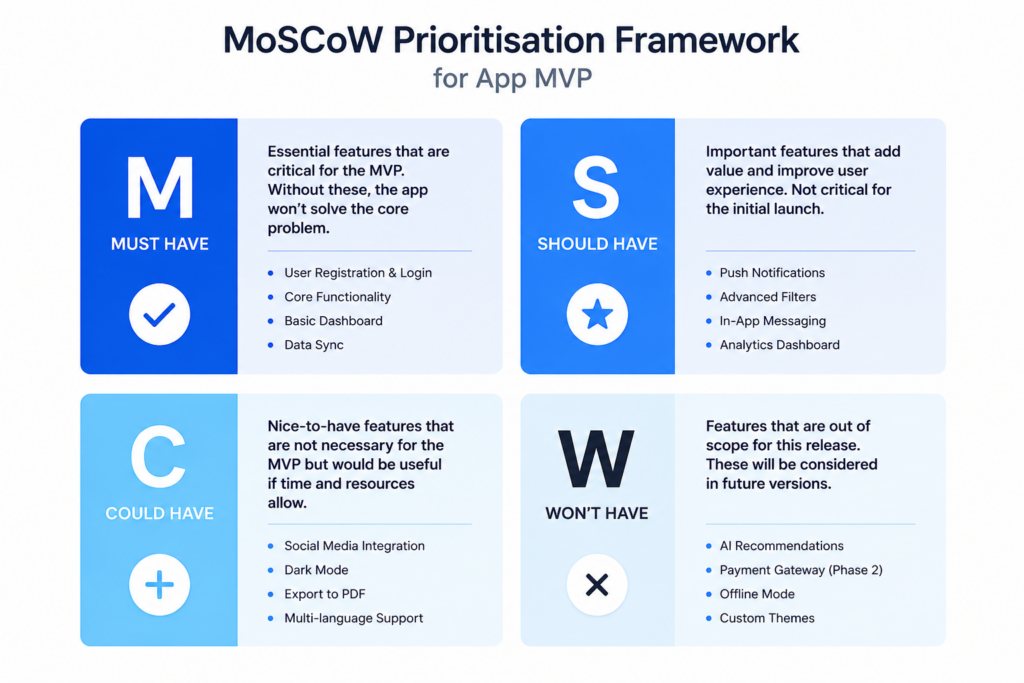
The most common MVP mistake is including too much. Use a MoSCoW prioritisation framework to define Must Have features — those without which the app fundamentally cannot function — and ruthlessly cut everything else for launch. A typical app MVP includes user authentication, a core user journey covering the app’s primary value proposition, basic data storage, and the minimum UI needed to make the experience usable.
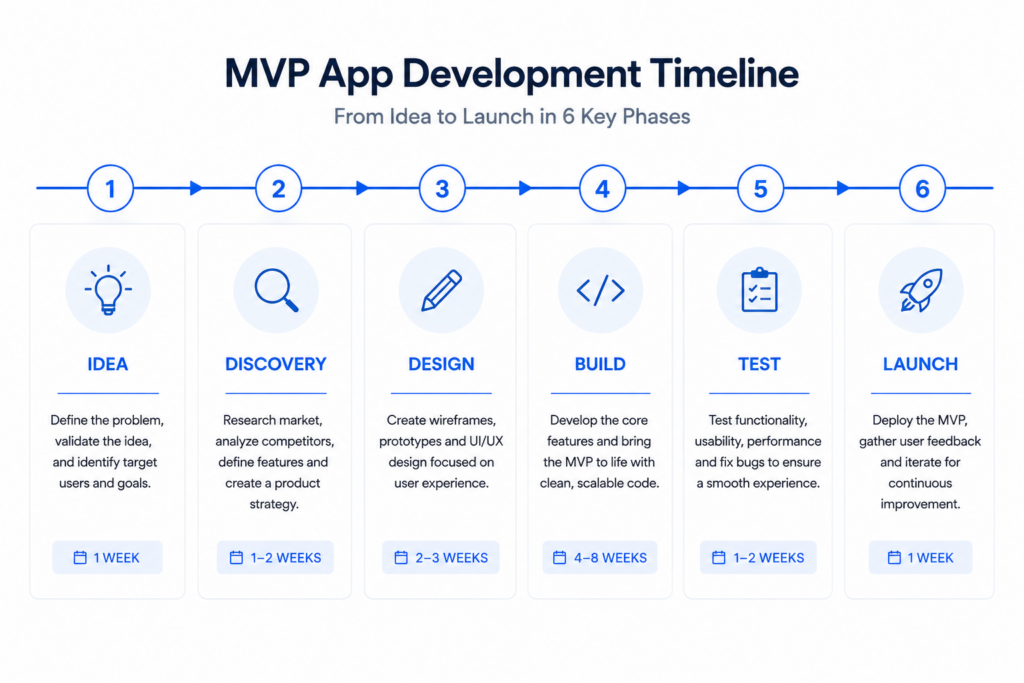
How Long Does MVP App Development Take?
A well-scoped mobile app MVP typically takes 10 to 16 weeks with an experienced team. This covers discovery and scoping (two to three weeks), UX design and prototyping (two to three weeks), development (five to eight weeks), and QA and submission (one to two weeks). Rushing any of these phases increases the risk of launching a product your users will not engage with.
| 🚀 BUILD YOUR APP MVP IN 12 WEEKS Stakk specialises in lean, focused MVP builds that validate your idea and position you for growth. Let’s scope your MVP today. |
Frequently Asked Questions
Common questions from founders and businesses considering MVP app development.
What is an MVP app and why does it matter?
An MVP app — Minimum Viable Product — is a version of your application built with only the core features needed to solve your users’ primary problem and test your core business assumption. It matters because it reduces financial risk, accelerates time to market, and generates real user feedback before you invest in full-scale development. Most successful apps today started life as an MVP.
How much does MVP app development cost?
MVP app development typically costs between £15,000 and £70,000 in the UK depending on the complexity of the core feature set, the platforms targeted, and the level of UI design required. A simple, single-platform MVP with basic functionality can be delivered from £15,000 to £30,000. More complex MVPs involving custom back-ends, third-party integrations, or sophisticated UX typically cost £40,000 to £70,000.
How long does it take to build an app MVP?
To build an app MVP it typically takes 10 to 16 weeks with an experienced team. This includes two to three weeks of discovery and scoping, two to three weeks of UX design and prototyping, five to eight weeks of development, and one to two weeks of QA and app store submission. The timeline can be compressed slightly by starting design and development in parallel, though this increases the risk of rework.
What features should I include in my app MVP?
Your app MVP should include only the features essential to delivering your core value proposition to your target user. Use the MoSCoW method to classify features as Must Have, Should Have, Could Have, or Won’t Have for the MVP. Typical MVP features include user registration and authentication, the core product journey, basic data storage, and essential notifications. Everything else should be deferred to subsequent releases.
What is the difference between an MVP and a prototype?
An MVP is a functional product released to real users for real use. A prototype is a simulation — a clickable mockup or demo — used to test design concepts and user flows before development begins. Both are valuable at different stages: a prototype validates design and UX assumptions early at low cost, while an MVP validates your product-market fit with a real working application.
How do I know if my app MVP is ready to launch?
Your MVP is ready to launch when it reliably delivers your core user journey without critical bugs, meets App Store and Google Play technical requirements, has been tested by at least a small group of real target users, and your team has a plan for collecting and acting on user feedback post-launch. It does not need to be perfect — it needs to be good enough to generate meaningful learning.
Can I attract investment with an app MVP?
Yes, a well-executed app MVP is a powerful tool for attracting investment. Early-stage investors and accelerators want to see evidence of product-market fit — real users engaging with a real product — rather than pitch decks and mockups alone. An MVP that shows user growth, retention, or willingness to pay gives investors the data they need to make a confident decision.
What happens after I launch my app MVP?
After launching your app MVP, the most important task is collecting and analysing user feedback through in-app analytics, user interviews, app store reviews, and direct outreach. Use this data to validate or challenge your initial assumptions, prioritise the next set of features based on real user needs, and plan your next development sprint. Most successful apps iterate through three to five MVP releases before reaching a stable, scalable product.
Should my MVP be native or cross-platform?
For most MVPs, cross-platform development using Flutter or React Native is the preferred approach as it delivers both iOS and Android from a single codebase at significantly lower cost and faster timeline than two native builds. If your MVP targets a specific platform exclusively — for example, an enterprise iOS deployment — native development may be more appropriate. Your development team can advise based on your target audience.
What mistakes should I avoid when building an app MVP?
The most common MVP mistakes are building too many features, skipping user research before development begins, under-investing in QA before launch, failing to instrument analytics to measure user behaviour, and treating the MVP as a finished product rather than a learning tool. The best MVPs are ruthlessly focused, well-tested for core journeys, and supported by a clear post-launch measurement plan.
| 🚀 VALIDATE YOUR IDEA. LAUNCH FAST. Stop overthinking and start building. Our MVP development process gets your app in users’ hands in as little as 12 weeks. |
About the Author
| Jack Tyson | Director, Stakk Jack Tyson is the Director of Stakk and has spent 12 years building mobile applications for start-ups, scale-ups, and global brands. With hands-on experience across iOS, Android, and cross-platform development, Jack brings both technical expertise and commercial insight to every project. 🔗 Connect with Jack: LinkedIn URL |
Blog Post 117 | Primary Keyword: MVP app development | Stakk Content Strategy | Published: June 2026
Estimated reading time: 7 minutes