

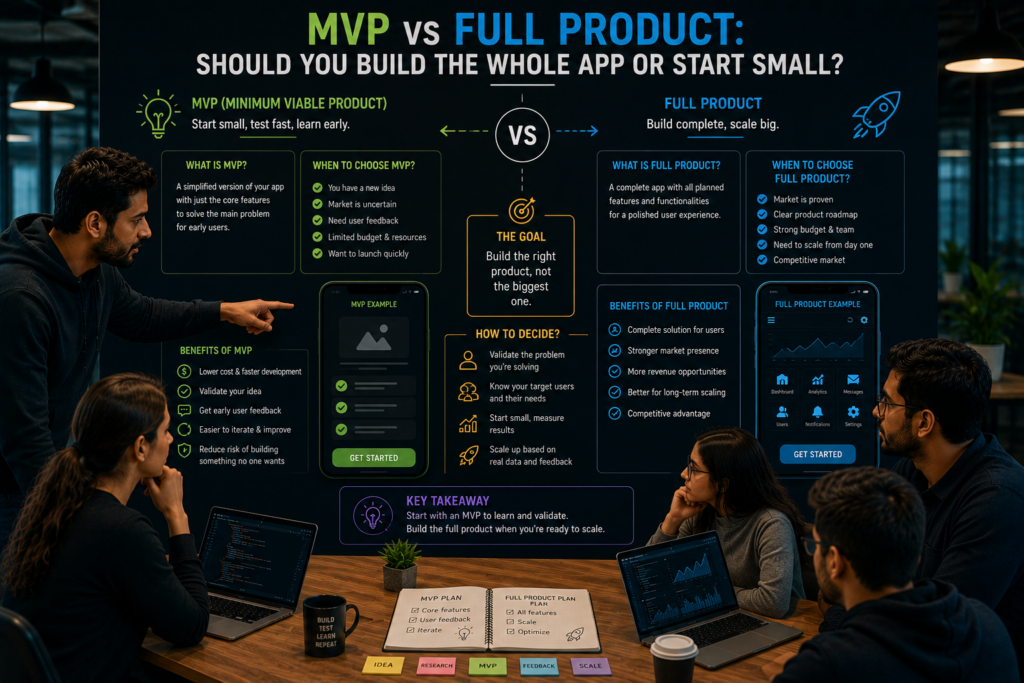
One of the most strategically important decisions any business faces when commissioning app development is whether to build the full vision from day one, or to start with a Minimum Viable Product and grow from there. It is a decision that significantly affects your budget, your timeline, your risk profile, and — most importantly — your chances of building something that users actually want.
This guide explains the difference between an MVP and a full product, when each approach makes sense, and how to scope your first version in a way that maximises your chances of success.
What Is an MVP? (And What It Is Not)
The term Minimum Viable Product was popularised by Eric Ries in The Lean Startup, and it has since been misused so often that it is worth redefining clearly. An MVP is not a bad version of your app. It is not a prototype. It is not an app with placeholder features. It is the most focused, valuable, complete version of your core idea — built with just enough features to deliver genuine value to your target users and allow you to collect real-world evidence about whether your product hypothesis is correct.
The ‘minimum’ in MVP refers to scope, not quality. An MVP should be as well-designed, as well-tested, and as carefully built as any other commercial product. The difference is that it does less — deliberately, strategically, and ruthlessly.
The purpose of an MVP is to answer a specific question as cheaply and quickly as possible: Will people actually use this? Will they pay for it? Does our core value proposition resonate with the audience we are targeting?
What Is a Full Product?
A full product is a comprehensive application that reflects your complete vision — all the features, integrations, user types, and capabilities that you believe the product ultimately needs. It may include admin dashboards, advanced reporting, multi-language support, third-party integrations, complex workflows, and a polished feature set that covers every use case you have identified.
Full products take longer to build, cost more, and carry significantly more risk — because you are investing everything before you have validated that users want what you are building.
The Case for Starting with an MVP
1. Reduce Financial Risk
Building a full product before validating demand is one of the most common and most expensive mistakes in technology. History is full of companies that spent £300,000 and twelve months building a comprehensive platform, only to discover that users did not want the core proposition — or wanted something meaningfully different from what was built.
An MVP lets you invest £30,000 to £70,000 to test your hypothesis, gather evidence, and make informed decisions about how to invest the remaining budget. If the MVP validates your idea, you build with confidence. If it reveals that your assumptions were wrong, you pivot before the financial consequences become existential.
2. Get to Market Faster
Speed to market matters. In competitive markets, the business that launches, learns, and iterates faster than its competitors has a structural advantage. An MVP can be built and launched in three to five months. A full product might take twelve to eighteen. In that time, a competitor could have launched, built an audience, and established brand recognition that is very difficult to displace.
3. Learn from Real Users
No amount of market research, user interviews, or internal brainstorming produces insights as valuable as watching real users interact with your real product. Analytics tell you exactly where users drop off. Support tickets tell you what features are confusing. App Store reviews tell you what people love and hate. An MVP gives you access to all of this learning while there is still time to change direction cheaply.
4. Attract Investment
A working MVP with measurable user engagement is significantly more compelling to investors than a pitch deck with wireframes. If your business model requires external funding to scale, an MVP dramatically improves your ability to raise at a reasonable valuation. Investors are buying evidence of traction, not potential — and an MVP is how you generate that evidence.
The Case for Building the Full Product
There are genuine situations where starting with an MVP is the wrong approach:
- Regulatory environments: Some industries — fintech, medtech, regulated financial services — require a complete, compliant product before you can legally operate. Launching an MVP that does not meet regulatory requirements is not an option.
- Enterprise sales cycles: If your product is sold to large enterprises with lengthy procurement processes, buyers may require a complete feature set before they will engage commercially. An MVP may not have enough to convince an enterprise buyer.
- Network effects at scale: Some products only have value when a large number of users are already using them — two-sided marketplaces, for example. In these cases, a stripped-back MVP may not create enough value to attract the critical mass of users needed to validate the product.
- Brand reputation risk: If you are an established business with an existing customer base and brand reputation, launching an incomplete product could damage the relationship you have built with customers who expect a certain standard.
How to Define the Scope of Your MVP
Scoping an MVP well is harder than it sounds. The natural instinct is to include everything — every feature, every user type, every edge case — ‘just in case’. Resisting this instinct requires discipline and a clear framework.
Step 1: Define Your Core Value Proposition
What is the single most important thing your app does for your user? Strip away everything else. If your app is a logistics platform, the core might be: a driver can accept a delivery job and navigate to the pickup point. Everything else — ratings, in-app messaging, fleet analytics, multi-depot management — is secondary. Build the core, and build it brilliantly.
Step 2: Identify the Riskiest Assumptions
What are the most important things you are assuming to be true about your users and your market? List them. Then ask: what is the minimum we need to build to test whether each assumption is valid? The MVP should be designed specifically to test your riskiest assumptions — the ones that, if wrong, would fundamentally change your product strategy.
Step 3: Use MoSCoW Prioritisation
Every feature request should be categorised as Must Have (launch is impossible without it), Should Have (important but not blocking launch), Could Have (desirable for a future release), or Won’t Have (explicitly out of scope for this version). Be ruthless with Must Have. If you cannot articulate why a feature is a launch blocker, it probably is not.
Step 4: Define Success Metrics Before You Build
Decide in advance what evidence will tell you the MVP has succeeded. A specific number of active users? A retention rate above a certain threshold? A net promoter score above 40? Revenue of a given amount? Knowing your success criteria before launch prevents post-hoc rationalisation and keeps your iteration roadmap grounded in evidence.
Scoping the Second Version
A well-planned MVP is not a one-off project — it is the foundation of a product roadmap. Before you launch, you should already have a clear sense of what version two will contain, subject to what the MVP data tells you. This second version is where you layer in the Should Have features from the original MoSCoW exercise, address the most common user feedback, and begin to build towards the full product vision.
The businesses that get the most from app development are those that treat it as a continuous programme of work, not a one-time project. An MVP launch followed by a disciplined iteration cadence — monthly or quarterly releases driven by data — is almost always a better investment strategy than a single large build.
Talking to App Developers About Your MVP
When briefing app developers on an MVP, be explicit about the constraints. Tell them it is an MVP. Tell them what you are trying to learn. Tell them what the success metrics are. This context allows the development team to make better technical decisions — choosing a flexible architecture over a brittle optimised one, for example, or avoiding premature investment in scalability infrastructure that is not yet needed.
A good app development agency will actively challenge feature scope during discovery, ask ‘do we really need this for launch?’, and help you defend the MVP boundary when stakeholders push for additions. That discipline is enormously valuable. Guard it.
Final Thoughts
For the vast majority of new digital products, starting with an MVP is the smarter, lower-risk, higher-learning approach. It gets you to market faster, reduces financial exposure, and gives you real-world data to build on. The key is to define ‘minimum’ in terms of scope — not quality — and to choose app developers who understand the difference.
The full product can wait. Your users’ feedback cannot.
Not sure whether you need an MVP or a full build?
We’ll help you work it out. A free discovery call with the Stakk team is a good place to start — no pitch, just an honest conversation about your product.
Book a free discovery call